 EN
EN

Ink by the Meter: Matching Thermal Transfer Ribbon Chemistry to Your Labeling Reality
Thermal transfer printing works by melting a ribbon coating onto a substrate through precisely controlled heat from a printhead. The coating chemistry — wax, wax-resin blend, or pure resin — determines scratch resistance, chemical durability, substrate compatibility, and print darkness. Selecting the wrong ribbon chemistry for the application produces labels that smear on contact, fade in storage, or fail to transfer ink onto the label material at all.
Ribbon Chemistry Fundamentals
Wax Ribbons: Cost-Effective for Standard Paper Labels
Wax ribbons use a coating composed primarily of paraffin or carnauba wax blended with carbon black pigment. When the printhead heats the ribbon, the wax melts at approximately 65–75°C and transfers to the label surface, where it resolidifies almost instantly. The bond is mechanical — the wax sits on the substrate surface rather than penetrating or chemically bonding with it.
This mechanical bond explains both wax ribbon strengths and limitations. On uncoated and semi-gloss paper labels, wax adheres well because paper fibers provide microscopic surface roughness for the wax to grip. On smooth synthetic substrates — polyester, polypropylene, vinyl — the wax bond is weak and easily abraded. A wax-printed paper label withstands light handling and short-term indoor storage but smears under friction, degrades with oil or solvent exposure, and fades under prolonged UV light.
Wax ribbons dominate high-volume, cost-sensitive applications: shipping labels, warehouse bin labels, retail price tags, and general inventory labeling where the label's functional life is measured in days or weeks rather than months. Hangzhou Sinoco Industry's SNW1300 premium wax ribbon is engineered for these standard paper-label applications across Zebra, TSC, and Honeywell printer platforms.
Wax-Resin Blends: The Mid-Range Workhorse
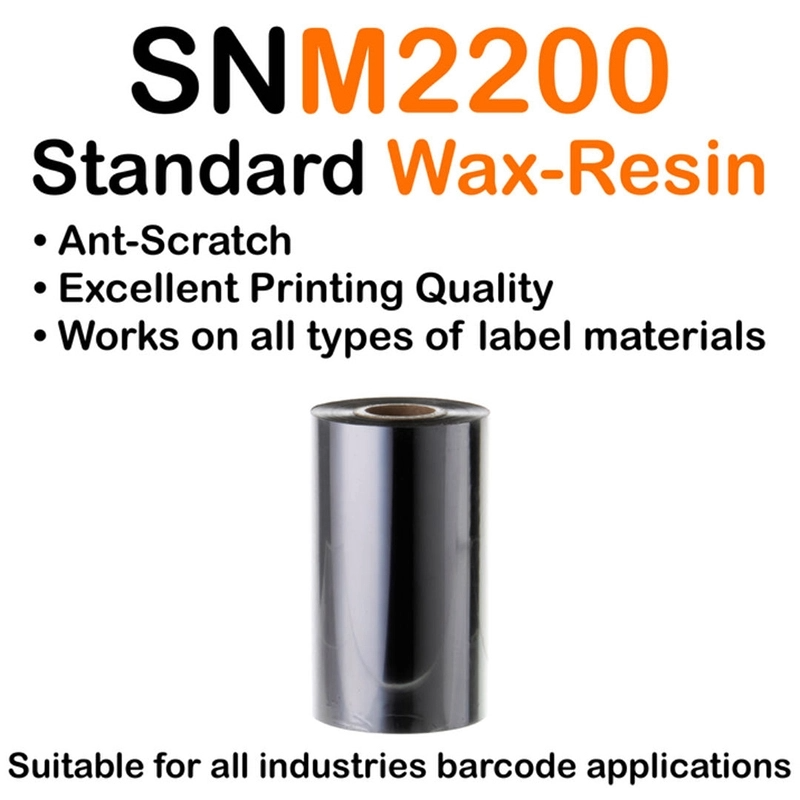
Wax-resin ribbons blend wax with synthetic resin — typically 30–50% resin content — creating a coating that melts at 75–90°C and forms a stronger mechanical bond with the substrate. The resin component provides three improvements over pure wax: increased scratch resistance (the resin acts as a hardening agent within the wax matrix), improved adhesion to coated papers and some synthetic films, and moderate resistance to water, alcohol, and mild cleaning chemicals.
Wax-resin ribbons serve the broadest application range in warehousing, logistics, and light industrial labeling. A coated-paper label printed with wax-resin ribbon survives outdoor shipping exposure for 2–4 weeks, resists smearing from handling during transit, and maintains legibility through moderate humidity cycles. Sinoco's SNM2600 premium wax-resin and SNM2800 super-premium formulations are specified for these mid-durability applications where pure wax fails but full resin over-specifies the durability requirement and increases cost unnecessarily.
Resin Ribbons: Maximum Durability for Harsh Environments
Pure resin ribbons melt at 90–110°C and the transferred coating chemically bonds with synthetic substrates — the resin molecules interdiffuse with the substrate surface rather than merely adhering to it. This chemical bond delivers scratch resistance that survives industrial handling, chemical resistance to solvents, oils, and cleaning agents, and temperature resistance from -40°C to 150°C+ depending on the specific resin formulation.
Resin ribbons are mandatory for: chemical drum labels exposed to solvent spills, automotive under-hood component labels experiencing heat and oil exposure, medical device labels requiring sterilization (autoclave, EtO, gamma), and outdoor equipment labels facing years of UV and weather exposure. The cost premium — resin ribbons cost 2–4 times wax equivalents — reflects the material cost and the narrower application window where nothing less than resin will perform. Sinoco's SNR6900 super-premium washcare resin ribbon addresses the most demanding durability requirements including industrial laundry cycles for garment-care labels.
Real-World Selection Outcome
A chemical distributor labeling 55-gallon solvent drums initially used wax-resin ribbons on coated-paper labels — a specification that seemed adequate based on the ribbon manufacturer's "chemical-resistant" classification. Within three months, customer complaints revealed that minor solvent drips during dispensing were dissolving the print and rendering hazard warnings illegible. After switching to Sinoco SNR6900 resin ribbon on polypropylene labels, the print survived direct solvent contact and 18-month outdoor storage. The per-label cost increased from 0.04 to 0.11, but the cost of a single illegible hazard-label regulatory fine exceeded the annual ribbon spend by a factor of twenty. For chemical labeling, the wax resin application matrix clearly placed this use case in the resin-only quadrant.
Frequently Asked Questions
How do I know which ribbon chemistry my labels need?
Match ribbon to substrate and durability requirement. Paper labels + short life = wax. Coated paper or light synthetic + moderate durability = wax-resin. Synthetic labels (PET/PP/PE) + harsh environment = resin. Sinoco provides substrate-compatibility testing for customers uncertain about the correct specification.
Can wax-resin ribbons print on polypropylene labels?
Wax-resin ribbons with higher resin content (40–50%) can print on polypropylene with acceptable results for indoor applications. However, the bond is still primarily mechanical, not chemical — full resin ribbons deliver superior adhesion and durability on PP for outdoor or chemical-exposure applications.
What causes ribbon wrinkling during printing?
Ribbon wrinkling results from tension misalignment between the ribbon supply spindle and take-up spindle, or from heat-induced expansion when printhead temperature is set too high for the ribbon chemistry. Verify ribbon tension settings and confirm the printer's heat setting matches the ribbon's specified energy requirement.
Do different ribbon chemistries affect printhead lifespan?
Yes — wax ribbons are the most printhead-friendly because they transfer at lower temperatures with less abrasive coating chemistry. Resin ribbons require higher printhead temperatures and harder coating formulations that increase printhead wear by approximately 20–30% over the same print volume.
What is the shelf life of thermal transfer ribbons?
Wax ribbons: 12–18 months. Wax-resin: 18–24 months. Resin: 24–36 months when stored at 5–35°C and 20–80% RH. Ribbons stored above 40°C may experience coating softening and blocking (layers sticking together). Sinoco's SGS and RoHS certified ribbons include production-date coding for shelf-life tracking.
Can I use the same ribbon across different printer brands?
Yes — thermal transfer ribbons are standardized by width, length, and core size, not by printer brand. A 110mm × 300m ribbon on a 25.4mm (1-inch) core works across Zebra, TSC, Honeywell, and Sato printers. Verify core size and ribbon width match the printer's specification; winding direction (ink-in or ink-out) varies by printer model.