 EN
EN


Print at Line Speed: Why TTO Ribbons Are the Backbone of Real-Time Packaging Marking
Flexible packaging lines producing snack bags, pharmaceutical blister packs, frozen food pouches, and personal-care sachets require variable data — batch codes, production dates, expiry dates, serial numbers — printed in real time as products move down the line. Thermal Transfer Overprinting (TTO) with near-edge ribbon technology delivers this capability at line speeds exceeding 600mm per second, printing high-resolution text, barcodes, and 2D codes directly onto flexible packaging films.
TTO Technology Fundamentals
How Near-Edge Printhead Geometry Enables High-Speed Transfer
Conventional flat-head thermal transfer printers position the printhead elements perpendicular to the substrate, with the ribbon traveling parallel to the substrate. TTO printers use a near-edge printhead geometry — the heating elements are positioned at the very edge of the printhead, and the ribbon peels away from the substrate almost immediately after the heated transfer point. This near-edge configuration allows the ribbon to run at higher speeds because the transfer-to-peel interval is minimized — the molten ink transfers and the ribbon carrier separates before any cooling or re-adhesion can occur.
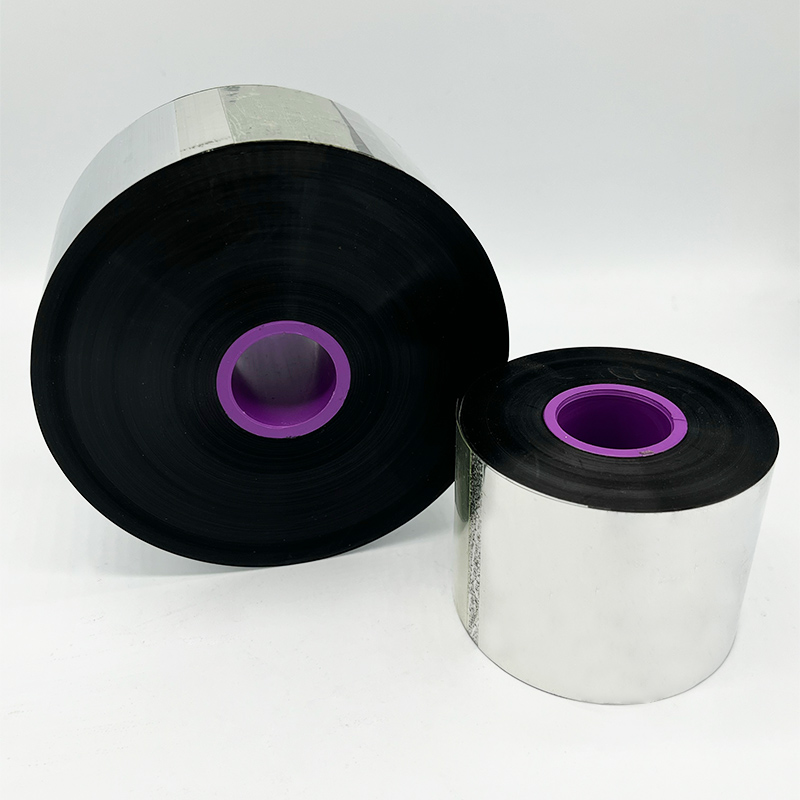
The ribbon itself uses a thin PET film carrier (typically 4.5 microns) coated with a wax-resin or resin formulation. The thin carrier enables rapid heat transfer from printhead to coating, reducing the energy required per print cycle and extending printhead life. Standard TTO ribbons are 20–55mm wide and 300–1,200 meters long, depending on the printer model and application requirements.
Hangzhou Sinoco Industry's TTO near-edge ribbon line is engineered for compatibility across major TTO printer platforms — Markem-Imaje, Videojet, Domino, and Allen coding systems — with optimized coating formulations that release cleanly at the near-edge peel geometry without residue buildup on the printhead.
Variable Data That Static Printing Cannot Deliver
Pre-printed flexible packaging films carry the brand design, ingredients, and nutritional information — static content that applies to every unit in the production run. TTO ribbons print the variable data layer: the specific batch code, the exact production time (down to the minute for pharmaceutical traceability), the unique serial number for anti-counterfeiting, and the expiry date calculated from the actual production timestamp rather than a pre-printed "best before" window. This separation of static print (done in advance on high-speed gravure or flexographic presses) and variable print (done in real time at the packaging line) optimizes both cost and flexibility.
Application-Specific TTO Ribbon Selection
Wax-Resin vs. Resin TTO Ribbons for Different Film Substrates
Flexible packaging films span a range of surface energies that affect ink adhesion. Polyethylene (PE) and polypropylene (PP) films — the most common flexible packaging materials — have low surface energy and require resin-based TTO ribbons for adequate adhesion and scratch resistance. PET and nylon films accept both wax-resin and resin formulations, with resin providing superior durability for applications requiring chemical or abrasion resistance.
Snack-food packaging (metallized PP with cold-seal coating) presents a particular TTO challenge: the cold-seal adhesive layer can contaminate the printhead if the ribbon coating formulation is incompatible. Sinoco's TTO ribbon formulations include cold-seal-compatible variants that prevent adhesive transfer to the printhead — a critical specification for snack-packaging lines where printhead contamination causes unplanned downtime.
Pharmaceutical Serialization and Compliance Printing
Pharmaceutical packaging regulations — EU Falsified Medicines Directive (FMD), US Drug Supply Chain Security Act (DSCSA) — mandate unique serial numbers and 2D data matrix codes on individual saleable units. TTO ribbons print these codes at production line speeds with the resolution and contrast required for pharmaceutical-grade barcode verification. The ribbon formulation must meet ISO 1831:2020 print-quality standards for barcode readability and resist smudging through the distribution chain.
Real-World Production Line Implementation
A contract manufacturer of private-label snack foods operating six vertical form-fill-seal packaging lines experienced 4.7% reject rates from illegible batch codes — the wax-resin TTO ribbon they were using transferred inconsistently on metallized PP film at line speeds above 400mm per second. After switching to Sinoco's resin-based TTO near-edge ribbon formulated specifically for metallized film adhesion, the reject rate dropped to 0.3%. The difference translated to approximately 124,000 fewer rejected units annually across the six lines. Printhead cleaning intervals also extended from every 4 hours to every 8 hours because the optimized resin formulation reduced coating residue transfer to the printhead surface.
Frequently Asked Questions
Are TTO ribbons interchangeable between different printer brands?
TTO ribbons are standardized by width and length but the coating formulation must match the printer's near-edge geometry and energy profile. Sinoco's TTO ribbons are formulated for cross-platform compatibility with Markem-Imaje, Videojet, Domino, and Allen printers. Verify the ribbon specification for your specific printer model.
What is the difference between TTO and standard thermal transfer ribbons?
TTO ribbons use thinner PET carrier film (4.5 microns vs. 6–12 microns for standard TTR), optimized coating release chemistry for the near-edge peel geometry, and formulations rated for higher print speeds (400–800mm/second vs. 50–300mm/second for standard desktop TTR). TTO ribbons are not interchangeable with standard thermal transfer ribbons.
How does TTO ribbon coating affect printhead life?
TTO ribbon coatings that release cleanly at the near-edge peel point minimize residue accumulation on the printhead — the primary cause of printhead degradation. Sinoco's TTO formulations are engineered for clean release, reducing the printhead cleaning frequency and extending printhead life compared to ribbons with incomplete coating transfer.
What resolution can TTO printing achieve?
TTO printing achieves 300 DPI (12 dots per millimeter) resolution — sufficient for high-density barcodes, 2D data matrix codes, and small-character text down to approximately 1.5mm character height. This resolution meets pharmaceutical serialization requirements and GS1 barcode standards.
Can TTO ribbons print on both sides of flexible packaging film?
TTO prints on the outer surface of the packaging film during the form-fill-seal process. Printing on the inner (product-contact) surface requires reverse-printed film manufactured in a separate pre-print process. TTO is designed for outer-surface variable-data printing only.
How does ribbon length affect production line changeover frequency?
A 1,200-meter TTO ribbon at typical 30mm print length prints approximately 40,000 impressions before requiring changeover. At 80 packs per minute, this represents roughly 8 hours of continuous production — a full shift without ribbon changeover. Match ribbon length to the production shift duration to minimize changeover-related downtime.